Last Friday David Taylor (CEO, CineForm) and myself presented at the LA Film Festival (thanks to Intel to sponsoring this event.) We had a really nice projector (worth $30k apparently) to show the latest in real-time post-production with Prospect 2k and CineForm RAW -- all running off a single dual core Intel processor, the next generation -- Conroe. Now if only we had time to promote this last minute event (last minute to us), some more of you could have been there. Here is an interview with D.T. at the LA Film Festival of on the topic of The Revolution Will Be Digitized by Jason Lopez of PodTech.net.
Also please check out the latest over on indiefilmlive.blogspot.com, the recent updates from the set of Spoon are engrossing.
Monday, June 26, 2006
Some recent events, CineForm related.

Sunday, June 11, 2006
Four Cores -- the More the Merrier
7/28/06 updated with even newer Intel performance numbers
---
We are now seeing a large number of users with dual proc dual core system like AMD Opteron 275s to 285s, and dual core HyperThreaded processors like Intel 965 Extreme Edition -- each of these systems present four processing paths for us to play with. Plus with quad-core single processors on the horizon, we have good reasons to do a little more with our threading architecture. The main reason I've haven't been blogging so much is that improving thread can be a real headache -- particularly as we are already pretty well threaded. Sometimes we might spend a week on a particular algorithm to realize we only got another 5% more speed -- and I want much more than that. For encoding we have N-way threading - that is really nice - and we've had that for sometime. It is made easier by the fact that we can encode many separate frames simultaneously on ingest -- we launch an encoding thread for every CPU available (real or logical core like HT.) Threading the decoder is not so simple, after all that has to be compatible with DirectShow, Premiere Pro and MediaPlayer, etc. Often threading tricks applied to the encoder don’t work as well with the decoder. We do now have an N-way threaded decoder for extreme playback, 4k etc, but not yet for editing – we’re still working on that.) Previously our products included an efficient 2-way threaded DirectShow decoding component which was ideal for single dual-core processors, dual Opterons 248-254 and HT enabled P4s. Yet on quad systems we were seeing the encoder is faster than the decoder (because of N-way threading) -- rather odd behavior for a symmetric compression technology (encoding and decoding should be similar in performance.) – Sorry, that was perhaps lots of boring background about the new threaded decoder that just shipped in all our products -- it will be up to 30% faster on quad system over the previous decoder.
On a related subject, it has been suggested that we make a standard encoder/decoder test suite to characterize real-time video processing performance on various CPU/memory/drive configurations. What do you think? Here is a sample of recent characterization we measured for the decode speed using a very demanding sequence captured from an XBOX 360 at 720p (note: consoles produce more demanding data then anything acquired by a lens -- a lens adds natural anti-aliasing which is easier to compress and playback, whereas gaming material typically has an infinite depth of field and harder edges. So HD camera playback rates are higher than these shown.)
| Machine | Decoder 2 | Decoder 3 | ||
| Yonah 2.0GHz, 667 FSB | 60.17 | |||
| Merom 2.0GHz, 667 FSB Merom 2.33GHz, 667 FSB (new data) | 84.42 - | 122.66 | ||
| Pentium D 840 EE 3.2GHz, 800 FSB | | 93.65 | ||
| Pentium D 965 EE 3.73GHz, 1066 FSB | 110.83 | 146.61 | ||
| Conroe 2.66GHz, 1066 FSB (next generation desktop) | 122.81 | 137.59 | ||
| Glidewell 3.2 GHz, 1066 FSB Woodcrest 2.66Ghz, 1333 FSB (new) | 117.74 - | 223.75 269.92 | ||
All numbers are in frames per second for a full-resolution, full-quality decode. Decoder2 is used in our Premiere Pro editing solution (Aspect HD and Prospect HD); its preview mode literally doubles and triples these numbers. Decoder3 is our N-way threaded presentation codec (think Digital Cinema.) The Glidewell's (new Xeon) 223.75 fps was due to the 8 threads (!) that can run on HT dual-core dual-proc Xeons (4 real cores.) 720p at 223.75fps equates to 100fps 1080p and 30p for 4k at 2.35:1 (note: higher resolutions are more efficient on compression, so the frame rate numbers are very conservative.) And we have more optimization coming. :)
New Data 7/28/06 : Same tests on the new Woodcrest Xeons hits 270 fps, with a lower clock speed than Glidewell and no HT. Amazing!
Note: For those who want AMD numbers, these processors are also very good (and have been for a while.) Yet we have older AMD systems in-house than these newer Intel boxes, so I can't show the best AMD vs the best Intel. Intel is certainly bringing-it-on and is currently the performance leader in our office; previously we only recommended AMD for Prospect HD Ingest - not so any more.
Saturday, June 10, 2006
Creative Cow Interview with Jacob Rosenberg
Here is the direct link to the Creative Cow pod cast, where Jacob Rosenberg discusses all things Premiere Pro with some focus on past, present and future HD/Film projects using CineForm. Plus he drops my name so I have to link it. :)
Interview with Jacob Rosenberg
Monday, May 08, 2006
Not that I like to be on TV,...
Studio Daily did a series of interviews on the NAB show floor regarding the new Silicon Imaging digital cinema camera. The final production features Ari Presler of Silicon Imaging demonstrating how the camera works and myself showing the advantages in post production using footage shot with CineForm RAW. This is a nice concise news story covering why this camera is so cool (I why I had such a blast demoing it.) See the video story here under Some Like It Raw.
Friday, May 05, 2006
Shooting begins with the SI1920HDVR camera
Please check out the latest IndieFilmLive blog entry . In that blog you can read about the first beta customer for the new Silicon Imaging digital cinema camera, and their experience with shooting directly to CineForm RAW. We get to watch with our figures crossed and hope that the first feature shot this way will be a huge success.
Thursday, April 27, 2006
Digital cinema cameras for everyone
Thursday is the last exposition day at NAB. As the floor is open for two hour less, the attendence drops dramatically. So it is on this day that the busiest of booth employees take a break and get to check out what the competition is doing. As I knew was coming home a day earlier, so a had already taken a good peak at all the other digital cinema camera vendors. These companies are not so much CineForm competition, more comparing those cameras that have licensed CineForm RAW to those that should. :) There are some pretty neat cameras in the bunch, all have a compelling stories, from those announcing cameras of the future such as the huge media buzz of Red and the understated annoucements from Colorspace, to the cameras almost shipping like the : Arri D20, Silicon Imaging's SI1920-HDVR and Vision Research's 65mm monster (4k at 125 fps with a IMAX sized sensor -- Wow!), all these have a home and they do displace film (some 16mm and some 65mm), with price ranging from a little above $10k to under $200k (and worth every penny.) I spent a lot of time at all of these camera booths, and everyone I spoke to really knows their stuff. This will be a very exciting 12 months.
As Silicon Imaging is the current vendor licensing CineForm RAW, you may have expected we knew everything about it, not so. I fact I had only meet one of the team members before at a previous NAB, all other business was done via internet and phone, plus a few test clips. We had never seen the camera until the weekend of NAB and I had just seen a picture of it a few days before. Now that I've back from NAB, I've had a little time to review the footage taken of the shoot using my borrowed Sony HC1. You can see some of the highlights in this 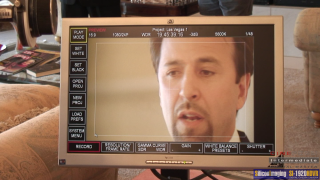 Windows Media clip with the camera being put through its shooting tests. The the resulting clips from the SI1920 where on display at the Adobe and AMD booths, and I believe some of this data will be uploaded to the Silicon Imaging's samples gallery.
Sunday, April 23, 2006
More images from the SI1920-HDVR shoot
Click on the images for greater detail. These photos came thanks to David Taylor, CEO CineForm.
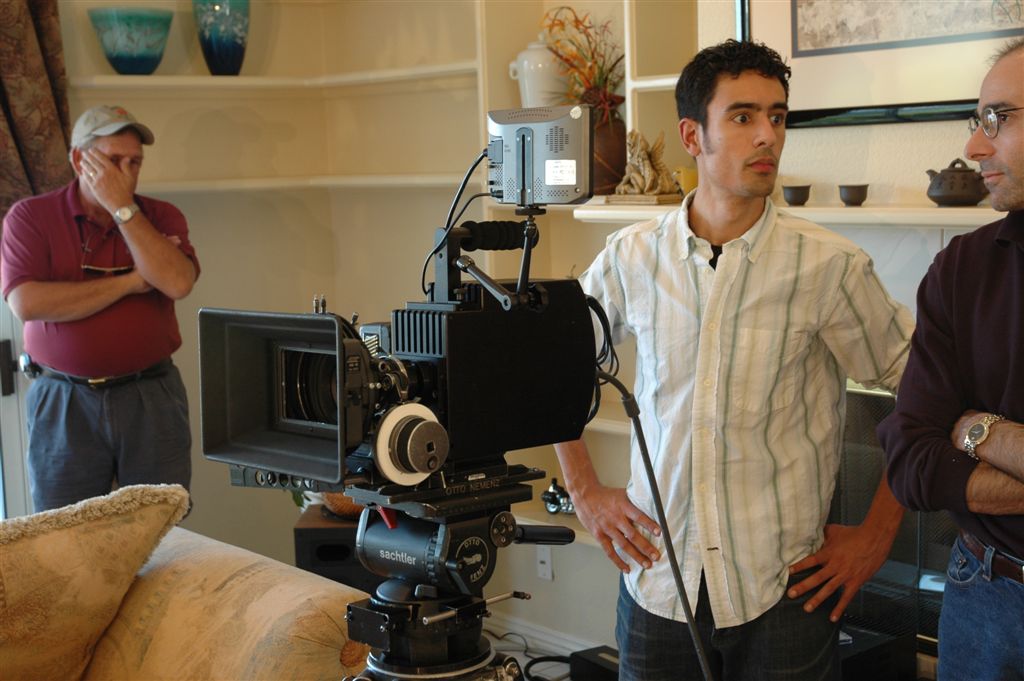 Jason Rodriguez -- one of the camera developers -- standing proudly behind the new camera. |
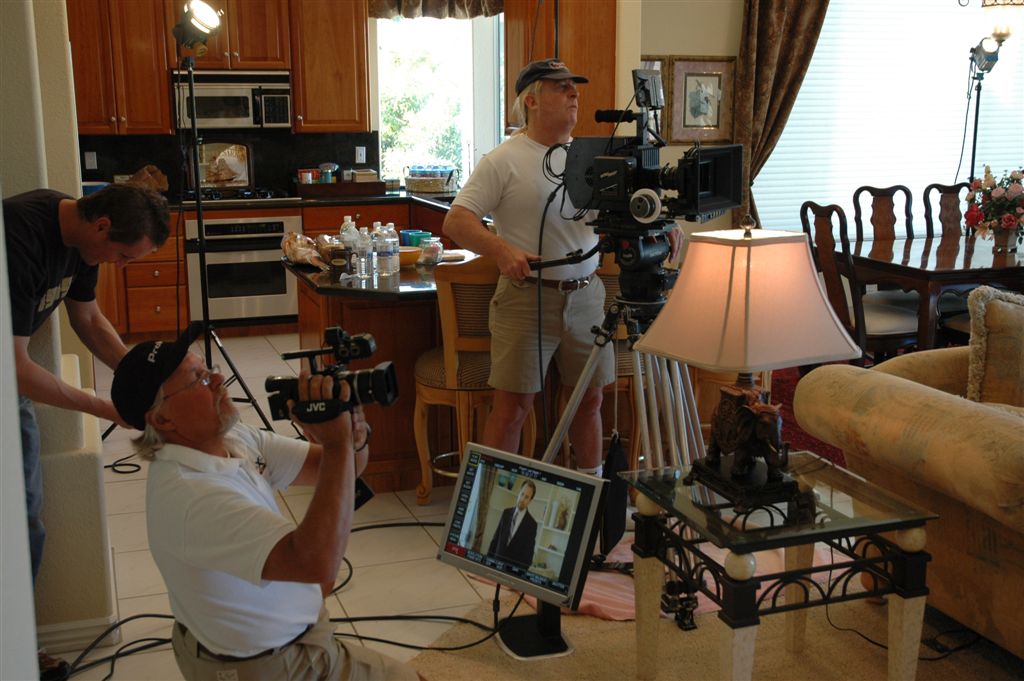 David Faires, a Director and DP, working the new camera. |
 SI1920-HDVR on stablizer |
 The control feed to an external 23" display, doing a shoot review. |
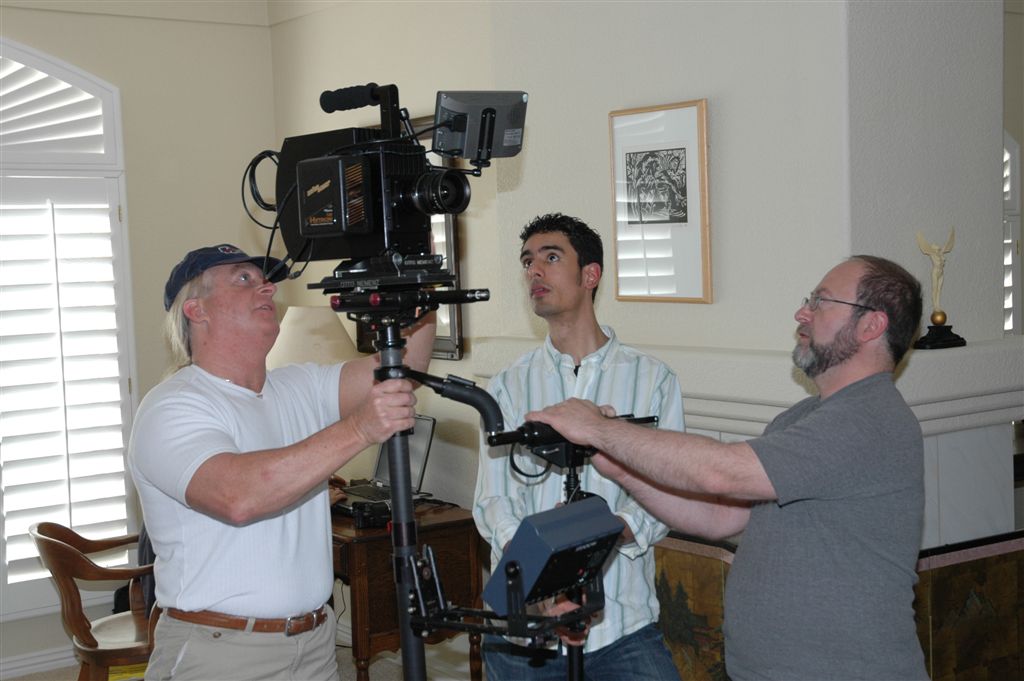 Setup. |
Subscribe to:
Posts (Atom)