Sunday, April 23, 2006

More images from the SI1920-HDVR shoot

Click on the images for greater detail. These photos came thanks to David Taylor, CEO CineForm.


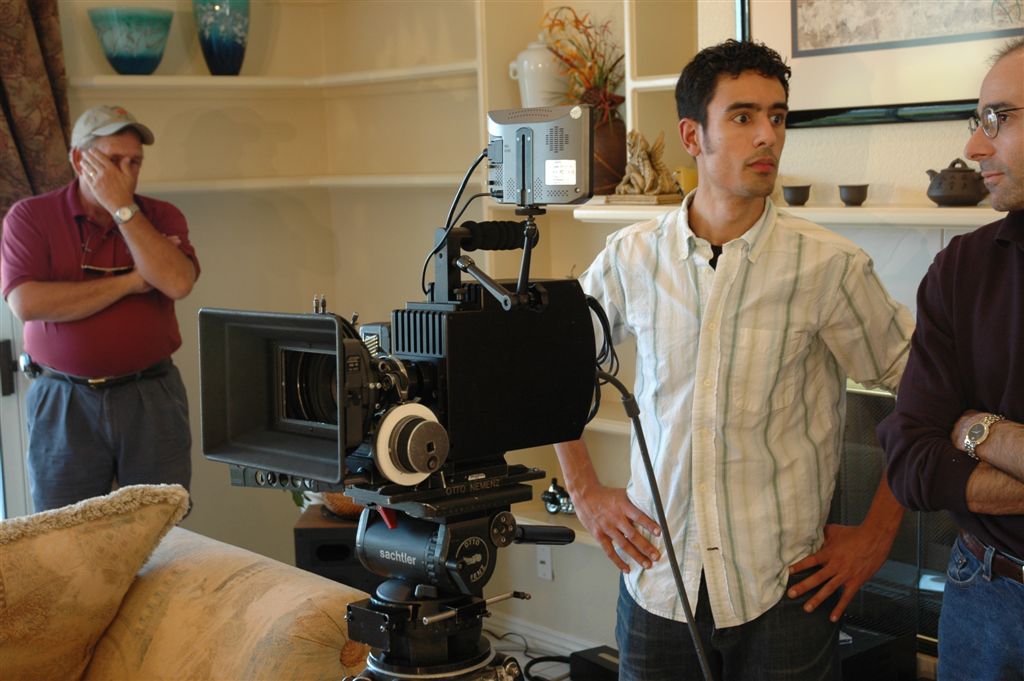
Jason Rodriguez -- one of the camera developers -- standing proudly behind the new camera.

David Faires, a Director and DP, working the new camera.

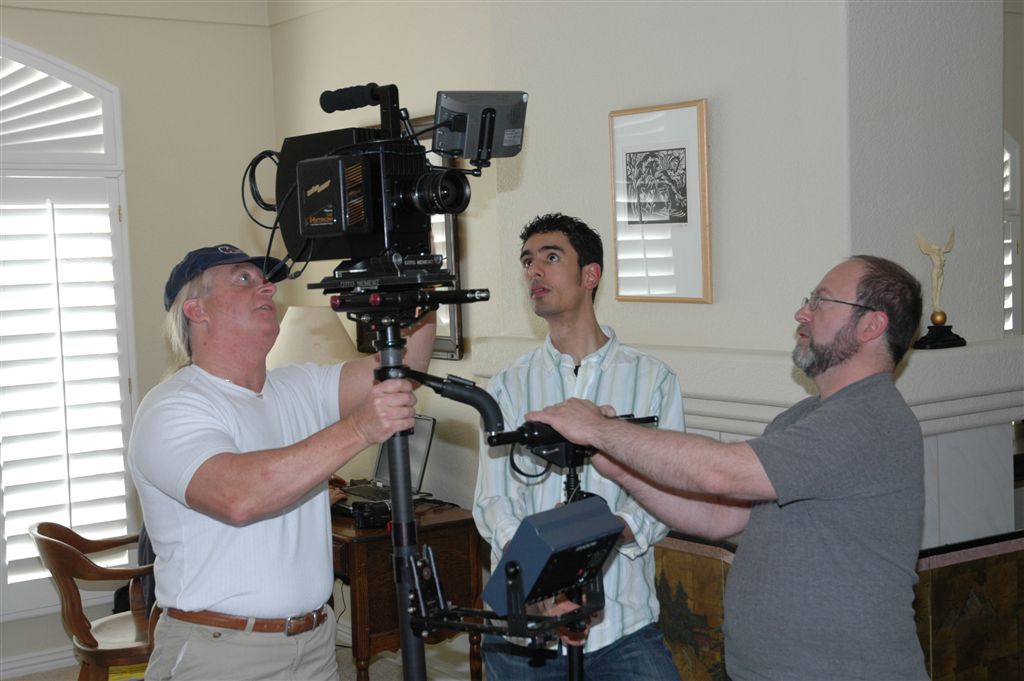
SI1920-HDVR on stablizer

The control feed to an external 23" display, doing a shoot review.

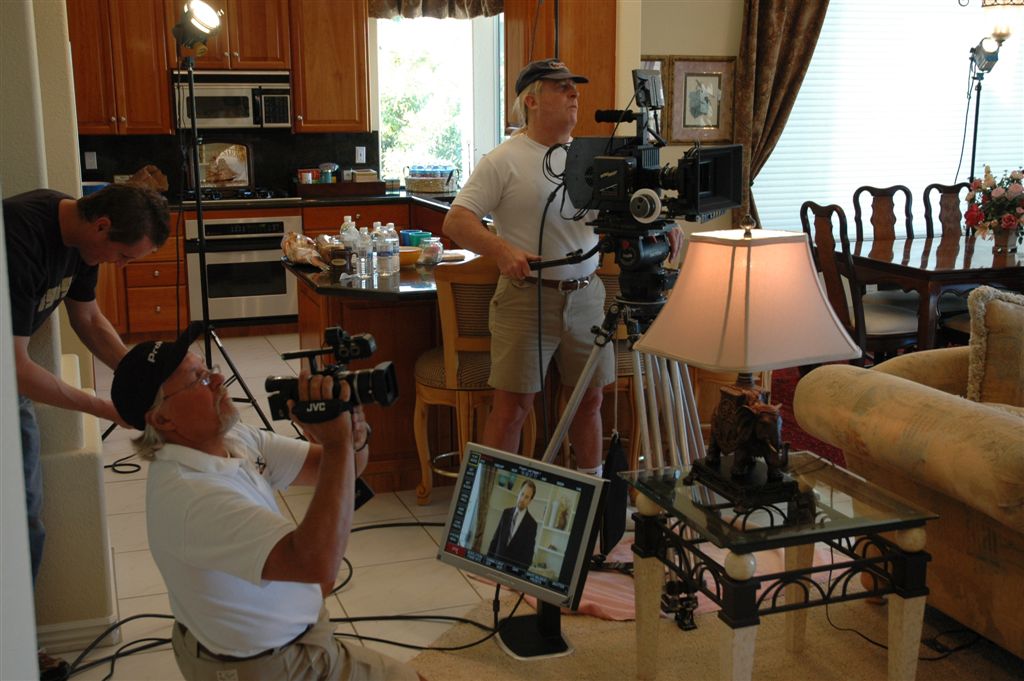
Setup.

Silicon Imaging camera in action.

This weekend the new SI1920-HDVR camera is in Nevada on a shoot just before its appearance at NAB (Abobe booth #SL3732.) I was unable to make it to the shoot, so I was very pleased to see that Jason Rodriguez has posted some images of the camera in action. David Taylor of CineForm was there will my Sony HC1 also documenting the event; best I could do without being there.

Wednesday, April 19, 2006

CineForm RAW™ in action.

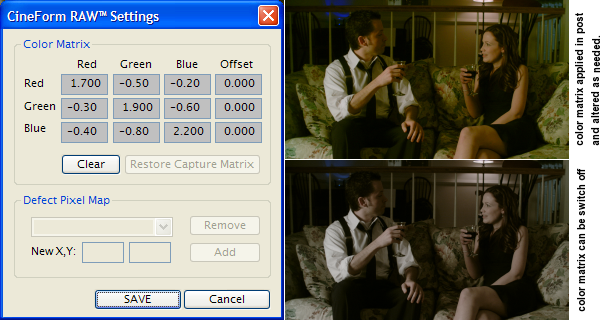
I thought a picture would help explain some of the benefits to the new CineForm RAW work-flow. The image on the top right is a clip from the sample footage posted over at the Silicon Imaging gallery. As I've have access to some the originals for this project, I can tell you these aren't color corrected images. They do however have a simple color matrix applied (not the default for this sensor), but as part of the CineForm RAW metadata, the color matrix can be turned off or tweaked in post before any color correction begins. So the base look of the top right clip is directors choice, before any primary or secondary color correction. Remember this camera allows much of the base camera look to be processed in post, color matrices are not "cooked-in" to the compressed image.

When I turn the color matrix off, you can see the image doesn't have a green tint, and is flatter and less saturated (image in the lower right.) All sensors natively produce this flatter image, which are much more suitable for obtaining the highest dynamic range of the image. Prosumer HD cameras pump up the image to make it look cool straight out of the box, this limits the dynamic range the degree the image can be corrected in post. Raw senor image data, like that of Viper Filmstream, Dalsa Origin or even Reel-Streems Andromeda also use this knownledge to create more filmic looking images.

The left most image shows one of the new control panels within Prospect HD at support the new work-flow for the SI camera, and hopefully more cameras soon. The color matrix is completely flexible, in addition there is a user controllable defect pixel map. All sensor can have pixels that deviate from the norm, and the SI camera, just like most cameras, will map these out before the image is encoded. Yet we all know that bad pixels can appear later in a shoot, or as the camera warms, so this control allow the editor to map them, just as the camera would have. Another benefit of RAW processing.

P.S. Some of the text is reproduced from my comments over on dxvuser.com.

Sunday, April 16, 2006

CineForm RAW™ -- this skunkworks project becomes a reality.

About two years ago I discovered an interesting group of people over in DVInfo.net's Alternative Imagining Methods forum. This is a wacky group of individuals set on building lens adaptors out of CD player motors, and their own HD cameras out of industrial sensors. To me this was a lot of fun, so I became a regular reader. I started noticing that many of these camera "inventors" where stuck in the mindset that uncompressed direct-to-disk was the way they were to create the ultimate cinematic experience. This was the common thinking at the time, with potential projects like Kinetta giving many the idea that anyone can do it (two years later Kinetta still hasn't released their camera.) I saw this "alternative imagining" world differently; why introduce a new camera that makes the post workflow harder? Uncompressed wasn't the answer, better compression was.

It was at this point I started to modify the CineForm wavelet codec to handle raw sensor data for this large single-sensor camera design. I knew this design would be the direction that low cost 35mm replacement cameras where likely to take. Today's high-end film replacement cameras like the Dalsa Origin, Genesis and the Arriflex D20 all use large single-sensor designs. Yet these ultra expensive cameras where not the low cost camera that I imagined for this new codec - I was thinking more Indie than Hollywood. Without a proven market for a new compression technology I pretty much worked on this project on my own time. I got some great help from very early adopters like Obin Olson (thanks again) who sent me some raw sequences from his camera experiments that enabled me to test the new codec and backend workflow idea without having a working camera at home. Initially these early images were 720p24, pretty straightforward for our real-time compressor on a desktop PC; the trick was to encode higher resolutions or higher frame rates on an embedded CPU (after all a P4 is a power hog.)

The first higher-resolution images came from Silicon Imaging (developer of the new SI-1920HDVR camera.) They loaned me (well really CineForm, but I took the camera home) an early 2M-3MPixel camera that could do 24p over a bus format called CameraLink. So I purchased a couple of cheap lenses off eBay and began coding a direct real-time compressor of the raw sensor data. Unfortunately my patience didn't mix well with the frame grabber SDK, so I end up getting the best images from Silicon Imaging directly, but the concept was now proven, and the SI relationship established.

Over the next year there were camera upgrades and the switch to Gigabit from CameraLink (thank you SI -- much nicer) but no standalone camera product was forming yet. Remember this was the time Prospect HD was in beta, while on-lining Dust to Glory, so the CineForm RAW project was still very much on the back-burner. Then at NAB 2005 I meet up with one of the Silicon Imaging team (Jason) for the very first time, and also met part of the Arriflex D20 engineering team. So, for a tradeshow demonstrating our existing products - HDV acceleration and the full launch of Prospect HD - there was lot of discussion about what CineForm could do for these next generation cameras. The Arri guys were very cool and sent me some pre-release raw data from the D20 camera head -- WOW! this image is so clean. The image is so damn clean the bit-rates of the compressed output were close to a CineForm 1920x1080 HD 10-bit data rate, yet the image was 3 times larger at 2880x2160. We proved we could encode this 6MPixel image on a dual proc. workstation at 24P, but unfortunately I couldn't get much more out of Arri. This sent me back to my original market problem, how to produce a successful software product if the only camera that can utilize it costs $100K+ (i.e. a rental model.) For a good software product you need volume - that means I needed a low-cost camera, something filmmakers could actually buy.

Now, having met one the Silicon Imaging team, the project really took form after NAB 2005, this would be the camera to launch a better filmmaker workflow. The development continued on both ends (CineForm & SI) over the last year, preparing for a full functional product to be shown at NAB 2006. The software is ready - Prospect HD has just been upgraded to support the CineForm RAW workflow, and the camera is ready for orders, shipping in only a few months.
That is a little of the history as to how we got here. If you haven't looked into it already, here are the direct links that explain why the SI-1920HDVR is such a cool and unique camera, and how CineForm RAW, makes post-production of raw image data completely seamless while enhancing the final results. We hope that CineForm RAW encourages more cameras to follow, from SI and others. Come check out the camera and Prospect HD (RAW) within the Adobe booth (SL3732 ) at NAB. (Hopefully we’ll have our own booth at a future NAB.)
Relevant links:

www.siliconimaging.com

www.cineform.com/technology/CineForm_RAW.htm
Monday, April 03, 2006

CineForm compression used for HD game development

Although CineForm has focused on compression and tools for the independent film and TV production / post environment, we have been getting a significant amount of interest from high-end game developers. The new consoles from Microsoft (XBOX 360) and the upcoming Sony Play Station 3 are producing HD images (1280x720 or higher) at 60 frames per second, that are sharper than anything gathered by a lens. So real-time compression from gaming consoles is an interesting challange, yet we now have customers using Prospect HD and/or Wafian HR-1 to real-time capture the latest games on the most advanced consoles. The applications are varied, from game testing and developement, to cutting together promotional demo reels (some as exciting as feature movie trailers -- thanks Richard for your great examples.)

So why CineForm? Basically we are a lot less expensive than an HD tape deck, and much more convenient than tape. Where you capture using an HR-1 or a Prospect HD system, your data is stored instantly of a computer for fast review and manipulation. As people play these consoles in a fixed location, the tethered acquistion into computer system is an easy solution. Next is quality, while capture 720p60 into DVCPRO-HD deck works, it will only samples at 960x720, limiting is usefulness when full pixel detail is important (again the deck is a more expensive solution.) Finally very long captures of entire gaming sessions will be beyond most tape systems and many uncompressed disk systems. All pretty obvious stuff, we are just excited by the opportunity of this alternative HD production market.

Tuesday, March 28, 2006

What's been going on?

It has been a very long time since I posted here, so wanted to give a snippet as to why. Back from the beginning of February I was out of the office for about 5 weeks, the longest I have every been away from work since coming to the US from Perth. This was really away -- no email or phone contact for much of that time. This was for positive family matters that I won't go into, but I only mention this much as I wanted to thank the San Diego division of Sony for loaning me a small HDV camera for this "trip." We have a lot of nice HDV gear at the office, but a Z1, HD100 or XL H1 is hardly suitable for personal use, and yet I'm completely spoilled now, such that a can't ever shoot SD again. So Sony kindly loaned me a HDR-HC1. I enjoyed it so much a bought one for myself upon my return. Thank you Sony.

Such a long time off work has put me way behind. If you emailed or left a message for me in the last two months (and I didn't get back to you) please try again. My presence on various HD forums got cut back to catch up on the office stuff. Much of the work awaiting for me was preparing Prospect HD 2.0 and it support for the new Premiere. Prospect HD 2.0 is adding support for the new Xena AJA LH and LHe cards, which is very cool for capturing pre-MPEG-compression directly from the camera head, really the best approach for effects work. Previously this option was only available with the Wafian HR-1 or via a component to HD-SDI adaptor. Much of the other work is preparing for the various announcements for next month's NAB (CineForm is in 5 or 6 partner booths again -- I'll be in Vegas Monday through Wednesday.) Expect April to be an exciting month for CineForm related projects.

Friday, February 17, 2006

Canon XL H1 Filmout Results - Awesome!

(Posted by David Taylor in the absence of David Newman)

In the blog dated Tuesday, January 17, I offered details for the 35mm filmout test we initiated with the Canon XL H1 shot in its 24F mode. During the shooting portion of the test, the XL H1 was simultaneously recorded to HDV tape and also to the Wafian HR-1 direct-to-disk recorder. In this post I’ll offer some subjective commentary on the results of the filmout.

After our first day of shooting (described below) we did a second day of shooting. In addition to the XL H1, the second day of shooting also included a Sony F900 that was recorded to HDCam tape in 24p mode. Unfortunately we did not have an HD-SDI module for the F900, and we acknowledge that recording to tape reduces its visual fidelity somewhat. When recording HDCam to tape the spatial resolution is 1440 x 1080 (same as HDV) with 3:1:1 chroma (versus 4:2:0) and 8 bits of precision (same). The filmout included the F900 material after it was ingested from HDCam tape. Comparatively, the CineForm Intermediate files are always 1920 x 1080 with 4:2:2 chroma and 10 bits of precision.

Of course viewing 35mm material on-screen is mainly a visual experience, and is inherently subjective. Perhaps the most consistent comment by all 20-ish of us who had the privilege of viewing the material was “Awesome!”. It can be stated emphatically that the XL H1 when printed to 35 mm film really looks excellent – colors, shadows, highlights, range, low noise, etc. It held up very well to the F900. I’m not sure why, and it was a surprise to us, but the F900 had a noisier appearance than the XL H1.

I’ve included a few image grabs from the test sequences used in the filmout that compare the XL H1 in its HDV mode and its D2D mode using the Wafian HR-1. The images were created by grabbing corresponding frames out of the video sequences and exporting them as bitmaps. Note that the source images were 10-bit CineForm Intermediate files, and the bitmaps are 8-bit files. As is evident in the images there is more resolution and more preservation of detail in the XL H1 D2D captures than the HDV captures. Unfortunately I do not have any F900 images to compare to. The F900 sequences were ingested at I/O Film during the recording session and were not grabbed separately on the editing workstation.

www.cineform.com/downloads-other/ColorChart-D2D.zip
www.cineform.com/downloads-other/ColorChart-HDV.zip
www.cineform.com/downloads-other/FabricChart-D2D.zip
www.cineform.com/downloads-other/FabricChart-HDV.zip
www.cineform.com/downloads-other/ResChart-D2D.zip
www.cineform.com/downloads-other/ResChart-HDV.zip

As a final comment, we’ve had the privilege of being invited to two additional camera test shoots also intended for 35mm filmout. Both shoots were performed earlier this week: One included the HVX200 and XL H1. The other included the Grass Valley Viper, shot in its HDStream mode, and the XL H1. We’ll offer more details on these shoots in the coming weeks after the filmout process.


Many thanks are in order for this filmout project, including to Robert Margouleff at Mi Casa Multimedia who initiated the project, Scott Billups for managing and performing the tests, Chris Angel at Mirage Productions for doing the post work, IO Film for doing the filmout, Birns and Sawyer for offering their facility for the first camera shoot, HDVision for use of their facility for the second shoot, and FotoKem for offering their viewing facilities.