After watching Alex's DVD (see last post) , my email in-box had another surprize. Jacob Rosenberg of Formika Films (Premiere guru and on-line supervisor for Dust to Glory) has released his latest project, Cactusflower, a music video for John Gold. The production of this music video received an excellent write-up and cover story in Video Systems magazine (see the article here.)
I have known about Jacob's new project for some time as I think this was the first production to use Prospect HD as a 24p disk recorder, bypassing the Sony F900 tape based compression. This allowed 10-bit for resolution 1920x1080 images to be captured rather than HDCAM's 1440x1080 8-bit. If he shot now, a Wafian HR-1 may have been an easier set-up, but the underlying technology is the same. A cool production fact: the F900 camera was shoot on it side, producing a tall 9x16 image, and the featured room was shoot in five slices to reconstruct a very wide anamorphic image, making a huge composite around 6000x2000 (from memory) to assemble all the slices into a seamless (very cool looking) frame.
See the truly excellent results here : “Cactusflower” video
Bonus : scroll down the page for a 720p WMV download version.
Monday, December 12, 2005
Excellent day for CineForm powered music videos

The best customer feedback
Early today I received a DVD of a music video produced by long time Aspect HD user Alex Raskin (www.FancyFlix.com.) It is always great to see what customers are doing with the software we create, and Alex's project is a lot of fun. Customer DVD's arrive every so often, but I do hope to encourage more of this. Please send them our way, we want to know what you are up to.
Friday, December 09, 2005
Aspect HD 3.4 now available for download
Yes another free upgrade for Aspect HD users. The biggest new feature is Canon XL H1 24F/30F support. It seems again that we will have an exclusive on this for some time based on the competitor's slow rate of support for JVC 24p (added to Aspect HD 3.3 released 4 months ago.) Here is the list of new features (cut from the CineForm web page.)
Codec:
- quality enhancements that triggered the recently published quality analysis performed using Connect HD in Sony Vegas have all been rolled into Aspect HD v3.4.
- upon uninstallation of Aspect HD, our decoder components (optionally) remain installed and active, allowing easy (and free) multiple-machine decoder installs.
Capture related:
- Batch capture with timecode supported for XL H1 and HD100U
- Batch capture now supports non-zero start timecodes
- Timecode extraction from HD100U streams now supported
Export-to-tape related:
- HD100U: both 24p and 25p exports now supported
- XL H1: 1080i and 1080p24 (pulldown added) exports
- Sony's HDR-HC1 and HVR-A1: now supported
24p modes:
- XL H1: Capture with pulldown removal yields 1080p24 progressive CineForm Intermediate files for pure 24p editing workflows
- HD100U: 24p capture already supported in Aspect HD v3.3 release
- 24p presets and editing modes supported for both the XL H1 and HD100U
25p preset added for HD100U
Standard definition 4:3 export now supported from 16:9 timeline (center crop) for DVD
For more information please visit the Aspect HD pages
Tuesday, December 06, 2005
Aspect HD 3.4 beta
Aspect HD 3.4 is almost ready for release will support for the 24F modes for Canon XL H1. Here is a happy new user of a new Canon editing with a beta of Aspect HD 3.4. I hope to post the new feature list shortly.
Thursday, December 01, 2005
Canon XL H1 24F over HD-SDI
Lots of new support is coming for the new Canon XL H1. The full CineForm product line-up will be upgraded (free) to support direct capture and editing of the 24F mode of the new Canon HDV camera (along with the 30F and 60i modes.) Support for HDV capture of 24F was straight forward, as the CineForm Intermediate approach bypasses all the ugly messing around with native MPEG, we had that running a couple of days after our first prototype arrived. (Note to camera manufactures, it is very helpful to get prototypes for timely software releases -- are you listening Panasonic?) Canon's 24F HDV stream is converted to a 24p AVI and the results are excellent. Yet the 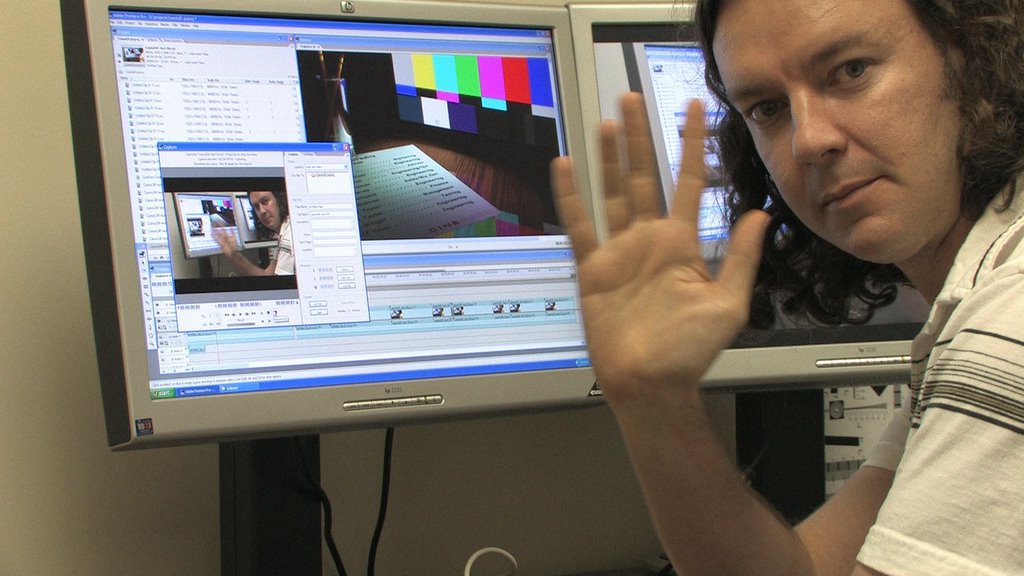 Canon XL H1 adds interesting possibilities via HD-SDI; as the 24F is presented with 3:2 pulldown over 60i at 1920x1080. The challenge was to extract the pulldown on the fly and only capture the 24 progressive frames (all in software of course.) This is what we achieved today, such that a pure 24p stream could be recorded directly to the disk in 10-bit CineForm Intermediate, ready for 24p editing. For these first tests I used AMD dual Opteron 275 workstation, a very nice system. Yet the pulldown and compression only uses 50% on the CPU resources, so this 24F capture mode will work on any qualified Prospect HD Ingest workstation (i.e. Opteron 250s or better.)
Here is a WM9 1280x720p24 clip showing direct capture from the XL H1. Not very exciting -- just me waving for a few seconds. I will post a full 1920x1080 p24 image when I have something more interesting to show.
This capture mode allows for 24p ingest while bypassing the camera's MPEG compression and preserving the full 4:2:2 color space the Canon places over HD-SDI. As a result this feature will also appear in the Wafian HR-1. Capturing this way is great for any project where quality needs to be at a premium. The 24p extraction greatly simplifies the post workflow. While you can record to other formats like HDCAM/SR, D5 or DVCPRO-HD, the resulting data stream is still 60i; the pulldown will still need to be extracted (which I understand can be tricky or cumbersome using off the shelf tools.) So again we have a first.
Sunday, November 20, 2005
10-bit workflow testing
In the last few weeks we a started a blog together with team of filmmakers in South Africa. This new blog (located here indiefilmlive.blogspot.com is allowing others to see and learn from a new independent filmmaker workflow. This is an effects heavy independent project that is really pushing the envelope; shooting multicam HD100s with 35mm lenses to Wafian disk recorders. CineForm and Wafian are optimized our tools to meet the needs of this project and the production team at Atomic VFX. This is all real, not a marketing exercise, if the filmmakers find bugs they will report them there.
In a recent thread on indiefilmlive.blogspot.com, there was some discussion of understanding the differences between 8 and 10-bit workflows. The Atomic VFX team was attempting to create a difference matte between 8 and 10-bit files, yet is turns out the compositing tools have some difficulty doing this. Read all the details at indiefilmlive.
Sunday, November 13, 2005
Meet the Filmmakers
A couple of days ago I was honored to attend an event thrown by AMD, Microsoft and the Austin Film Society. This was my first trip to Austin (unfortunately only for a 20 hour visit) but I will definitely return. The event was very well attended by Austin area filmmakers for primarily a social gathering with some short presentations from some celebrity filmmakers : Mike McCoy (producer and star of Dust to Glory) and Robert Rodriguez of Troublemaker Studios (writer, director Sin City, Spy Kids 1,2 & 3, ...) I was attending as the sole demo artist, showcasing what CineForm products can do for the indie filmmaker. Now this was not a tradeshow, this is a party with an open bar in a 6th St. night club, hardly the venue to demo software technology. Yet many brave filmmakers did choose to approach the long haired geek (myself) amongst the glowing computer gear.
This was a great learning experience for me, as this was a far better cross-section of indie filmmakers, than those that go to NAB or SIGGRAPH. So even at an event thrown by AMD and Microsoft, there were a lot of Final Cut Pro users, but more amusingly many assumed I was demonstrating FCP (I repeat, at an AMD/Microsoft event.) It is true that Adobe Premiere Pro does look much like FCP, and for good reason, it is aiming to be the FCP of the PC (and has pretty much succeeded technically in most areas.) There is now no longer that great divide between the feature sets of the competing low cost (pro) NLEs on either platform. The market potential that created the FCP phenomena doesn't exist today, yet the illusion still exists. I think many viewers of my demo assumed I was using FCP; after all, they have seen FCP do cool stuff (and no one can market better than Apple.) When I explained that, no, this was Premiere Pro running CineForm's Prospect HD/2K, the follow up question was often, "Can I do that?" on FCP, and the answer, again, was no.
It's not what I was showing couldn't be done under FCP in the future, but some of the same forces that have PC dominating the desktop are again at work against Apple. Compared to Premiere Pro, Final Cut Pro is a closed architecture, all major new features must come for Apple alone, third party vendors can only really enhance existing features within the product. Premiere Pro, on the other hand, is open, with a hardware abstraction layer (HAL) that allows thirds to add and extend beyond the core feature set. For example, integrated HDV editing within FCP could only come from Apple, whereas the intial Premiere HDV editing -- way ahead of Apple -- came from small third parties like Main Concept and CineForm. Apple's FCP certainly has lost some gloss over the HDV introduction, and even today users have no support for 24p HDV (unlike various PC solutions, including CineForm.) Not that Adobe alone has great HDV either, yet it is greatly supplemented by third party integration. Apple has plenty of compelling reasons to create a good HDV implementation, as this prosumer format is heading to become the new DV, which equates to lots of platform and software sales. However, the many smaller niche markets can't be served by Apple engineering, creating opportunity for companies like CineForm (but unfortunately for Apple this is easier to do on another platform.)
The niche market that has opened up though FCP's closed archecture are tools and workflows for independent filmmakers, the market that used to be FCP's turf excusively. The independent filmmaker is looking for the most cost effective solution to post his or her project, without compromising the final product. A simple enough desire, yet the allure of HD has complicated matters greatly for these filmmakers. It is very expensive to post and online HD production, forcing most into an offline workflow (an alien experience for DV shooters.) Even offline has additional expense such as the conversion cost from creating offline ready DV dubs from a HDCAM shoot (approx. $80 per 40 min HDCAM tape equals thousands for an average feature) -- then the online costs are still in the production's future. The offline then online approach is the typical FCP workflow, as it is for Avid, really it is the traditional workflow. Yet the indie filmmaker is not concerned with tradition -- neither Mike McCoy nor Robert Rodriguez were speaking at this event because they followed tradition.
So what did I demo at this event and how does it differ from the traditional workflow? I was showing the first 10 minutes of a feature shot on super-16 scanned at 2048x1276 10-bit log (26% more data than 1920x1080 HD) yet this 2K project fit in 10GBytes (which I had backed up on my iPod.) This project was playing on a dual opteron workstation, with the 2K media running from two drives in a simple striped RAID 0 configuration (inexpensive and standard.) On this system I showed that I could playback and mix three of these 2K sequences all in real-time. Three streams of 2K is simply not possible in any other practical workflow. What this all means is the tranditional off-line workflow can be entirely skipped. Now the workflow is free the the rigid ordering of : offline editing -> lock down -> conform to uncompressed -> complete FX work -> flatten the timeline (render, otherwise it won't even preview) -> color corrector (render) -> master out. With a compressed online workflow, steps can be performed in any order, and as you have the resolution image available at all times, HD dubs are ready available for marketing your project, all on much lower hardware costs. Under FCP for a 2K (film) or HDCAM projects, all you get is either a single stream compressed or single stream uncompressed -- no real-time, no workflow enhancement. For Apple to compete they need to open up FCP's achitecture to allow third parties to keep their product moving forward.
In the end, the idea of a compressed digital intermediate is not new; it has been around for may years as real-time DV editing. All CineForm has done is removed the bit-rate and resolution limitations of these camera formats DV, HDV, and DVCPRO-HD, and made film and HD resolutions edit as easy as a DV project without the quality compromise of all the camera based compression. An old workflow re-invented for a new filmmaker.